How to Get Found on ChatGPT: A Guide to AEO (Answer Engine Optimisation)
Before we go any further, there’s something super important to understand about how this all works…
The difference between Google and an Answer Engine
AI answer engines like ChatGPT are not search engines.
They are probability engines.
That means they don’t rank websites in a fixed order of positions like Google. Instead, they predict the most likely answer based on the information it was trained on and what it can access online.
This is why when you ask the same question twice, you get slightly different answers depending on the context of the previous conversation, or the way in which the question was asked.
With Google, we’ve been given a LOT of guidance over the years when it comes to SEO. We know what helps you rank.
With AI?
Not so much.
AI tools gatekeep information. They decide what gets surfaced – but they don’t share the rules of the game.
And to be honest… they’re probably not in a rush to. Especially with ads and monetisation becoming part of AI search.
So instead of trying to “figure out the algorithm”… the focus stays pretty much the same as it always has been; we focus on becoming the clearest, most trustworthy answer available.
Whether you call it AIO (AI Optimisation), GEO (Generative Engine Optimisation), or the far more relatable…
“How do I get ChatGPT to recommend my business?” …it all means the same thing.
I call it AEO. Answer Engine Optimisation. As it’s what I specifically trained in with the Chartered Institute of Marketing in 2026. And it’s a term that covers all answer engines, so it feels more fitting.
(Note: AI overviews in Google IS an answer engine just like ChatGPT, Gemini and Claude)
What does Answer Engine Optimisation (AEO) actually mean?
“Optimising your online presence so Large Language Models (LLMs) like ChatGPT, Gemini, Claude and Perplexity can understand you, trust you, and confidently recommend you”
So this is the new level of visibility. And hardly anyone is talking about it - yet.
But trust me, it’s here. It’s not coming. We’re in it right now, and it’s moving pretty fast. So much so, I’ve updated this blog post twice in as many months.
But like I always say: Let’s make your website hustle so you don’t have to. (Yes. I do say this. A lot.)
I’m all for energy smart marketing and SEO and AEO is the way to go.
Why Answer Engine Optimisation Matters (and Why It’s the New SEO) so you can get found on ChatGPT
AI tools are quickly becoming the place people go to first to find help.
You’ve probably done it yourself.
Instead of Googling, you pop into ChatGPT and ask:
“Where can I find the best deal for an Apple Laptop?”
“Are there any business networking events near me that are inclusive?”
“Who can help me with my SEO?” (I’m still working on getting found for this!)
It doesn’t involve scrolling or working through 20 tabs. You get a fairly clear answer, and someone else (AI) does the legwork for you.
For my clients, it was an accidental occurrence. I obviously work on SEO, but my clients were coming to me and telling me their customers were saying, “I found you through ChatGPT.”

And not because those clients had huge websites or massive followings. (One of my clients runs an online business without a Facebook or Instagram account!) but because their website was clear, consistent, and easy for AI to understand.
So, me being me, I started testing. Researching and trying to find out why this was happening.
Was ChatGPT just picking up Google searches, or was there something more?
I spent months playing detective in ChatGPT - trying dozens of prompts, adjusting website copy, tweaking titles, adding credentials, removing fluffy language - all to see what actually affects whether ChatGPT recommends or quotes someone.
From my research, and training with the CIM, I’ve now distilled everything into the four signals that AI looks for when recommending a business.
Welcome to my FACT Framework™ - Foundations, Authority, Clarity, Trust.
These signals are your roadmap to getting found in ChatGPT.
The Four Signals AI looks For (The FACT Framework™)
These 4 signals create a super strong framework that when utilised, mean you become the obvious recommendation and choice for AI.
Let’s break them down with the real client stories and examples.
F = FOUNDATIONS: Your SEO building blocks that Google looks for
SEO foundations are the things you need to rank well on Google. If you’re not getting found in Google, it’s much harder for AI to find and trust you.
Foundations are the things I check in the first 10 minutes of any SEO audit, but now they matter just as much for AEO. If you want to get found in ChatGPT, you gotta start with the foundations.
Fun (or not so fun, depending on how you look at it) fact – there are over 200 elements that Google looks for when ranking you in searches.
I don’t know all of them. Anyone who tells you they do is lying.
But what I do know is that there are some pretty big ones to target first.
These include:
Make sure your website is accessible to AI
Your website needs to be crawlable and accessible to AI bots.
If your site blocks bots (either intentionally or through your settings), AI tools may not be able to read or reference your content at all. Sometimes this happens in big organisations. Someone has decided to block AI because of IP, but that now means you lose out on answer engine visibility.
If AI can’t access your site, it can’t recommend you.
Clear headers (one H1 per page)
Does your first header on your homepage say ‘Welcome’? No shade – you wouldn’t know any different! So here’s the deal with H1s (header ones). Each page needs a H1. Just one. That H1 needs to have the keywords for THAT specific page.
If you changed that “Welcome” to: “Therapist for teens with Anxiety”, not only does that hit a juicy keyword search, but ChatGPT instantly knows who you are, what you do, and who you do it for.
Meta titles that hit keywords
Your meta title is that title you complete in the settings of every page. The one you’ve probably seen and wondered what the heck it is. It’s the one that shows up in the Google searches. Your keywords need to go in there too. If you leave it blank, Google will likely take the page title – which might be fine – but you’re likely better off choosing it yourself.
‘I’m the expert of this subject’ page – also called a content pillar page.
You’ve probably heard of content pillars and pillar pages. Blah blah blah. It's just a page that goes into great detail about one of your expert subjects. You might have one, you might have two or three distinct and clear areas. Prioritise getting at least one done.
Structure and internal linking
This helps with clarity. Not only do you want a clear pathway around your content; service pages, blog pages around questions about your specialist topic, they all need to connect. Link them up. So your website looks like a spiderweb of rich expert information.
Speed & Responsiveness
Does your website load in a good time (there are online checkers you can use), and does it look good on mobile? Mobile is now used more than desktop, so it’s even MORE important.
Where ChatGPT Gets Its Information
ChatGPT doesn’t actually use Google - it works on Bing! I know right? Which means we need to start looking at rankings in Bing now, as well as Google! There’s a game-changer for you.
That means your visibility isn’t just about Google anymore.
If you’re ignoring Bing completely, you could be missing opportunities to get found on ChatGPT.
A = AUTHORITY: Show AI you’re legit (Chatty isn’t going to recommend anyone dodgy, it’s got a reputation to uphold!)
Now we’re getting more into AI territory.
This is the section where people usually cringe… but it’s also where most of the wins happen.
✔ Qualifications matter — a LOT
Chat needs to see ou can prove your experience. Accredited bodies, CPD training – it all matters. When it comes to recommendations, it’s going to go for the qualified people. How does it know what qualifications and accreditations you have? You’ve got to spell it out in black and white. Bots read words - not images.
✔ Reviews are HUGE
Getting reviews on Google is best, because that all helps with SEO. But anywhere that’s independent of you is essential.
✔ Long-form testimonials
More than just “Sam is amazing!” – AI wants to see the real-life transformations. Think case studies and long form.
✔ PR and podcasts
These are gold for backlinks (links to your website from reputable sources) and give lots of additional juicy content to firm up your authority in a specific subject matter.
✔ Entities: How AI Understands What (and Who) You Are
AI doesn’t just read words – it also understands a thing called entities.
An entity is a clearly defined thing that search engines and AI recognise. For example:
– A person (you, your name, your brand)
– A business
– A service (like “SEO consultant” or “dog trainer”)
– A topic (like “anxiety therapy” or “Squarespace design”)
When your website connects you to these entities, AI can confidently understand who you are, what you do, and when to recommend you.
This is why vague language doesn’t work. (Or sometimes the language I refer to as a bit fluffy.)
The clearer your associations are, the easier it is for AI to “place” you in an answer.
C = CLARITY: If AI can understand you, then so can your website visitors
Clarity I believe is the number one reason people don’t get recommended in ChatGPT. I had a client who was nowhere to be seen in recommendations – but as soon as we tidied up his website and added in some clear content with keywords that explained that HE was the expert in his niche, added in all of the authority signals above and tadah! He started being recommended as the expert in ChatGPT! This is why I choose clarity over everything.
Here’s the proof:
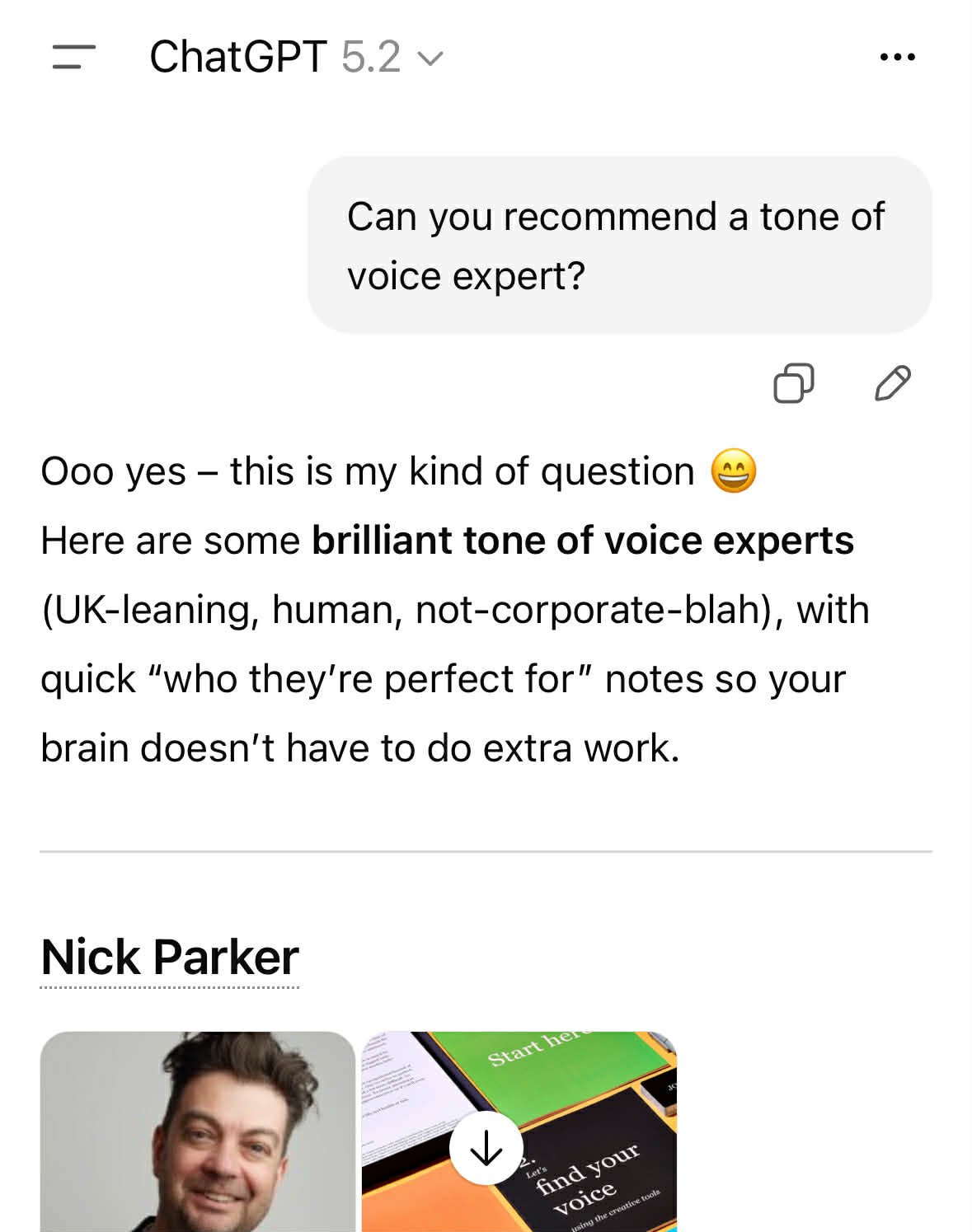
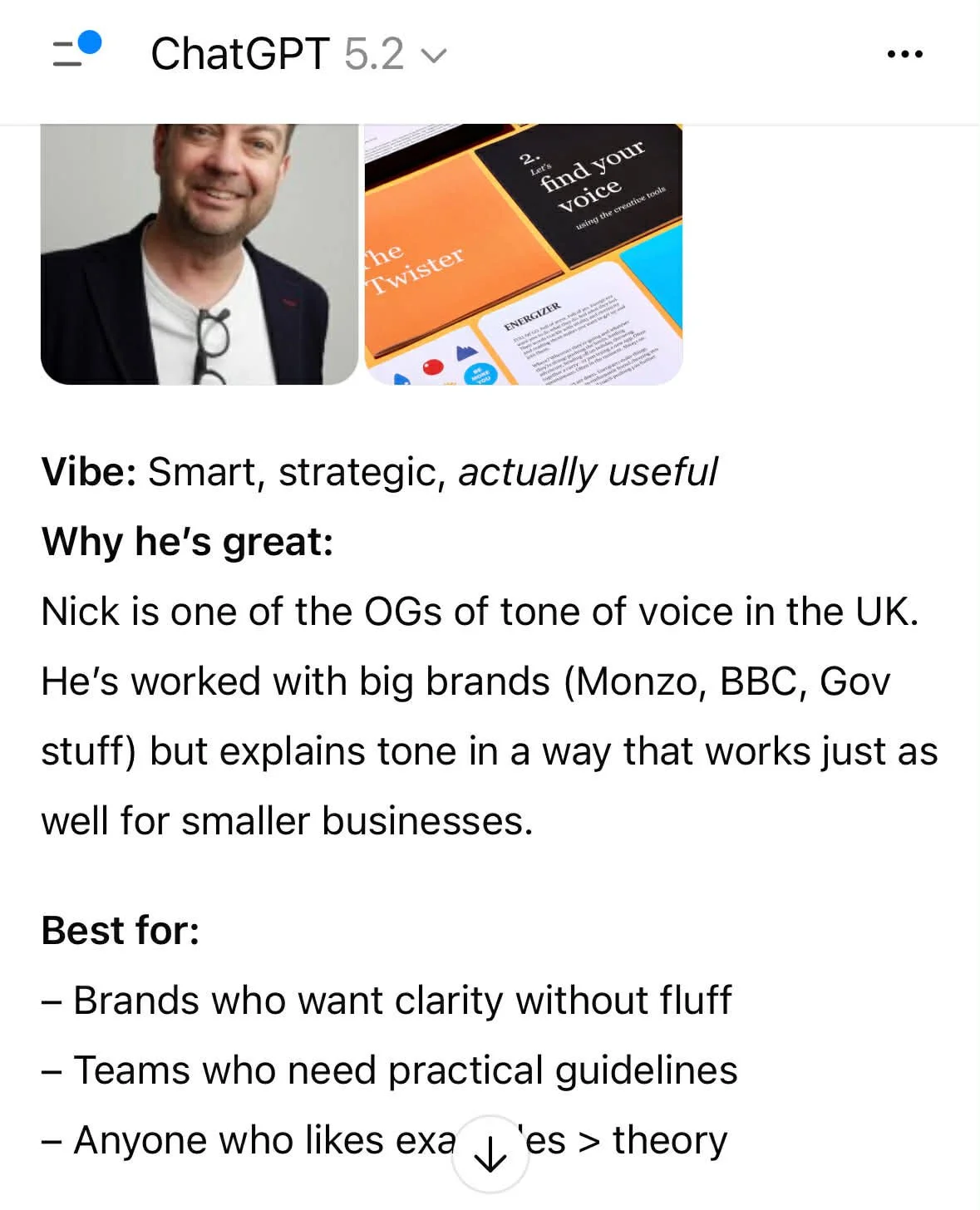
“The Manifestation Maven Problem”
I’m sorry to all the manifestation mavens out there – this isn’t personal. It’s a beautiful title. And I totally see why you might not align with the title the world “puts” on you. But you need plain speak in your content so AI (and your audience) understands what you do and who you do it for. If you’re a business coach who specialises in accountability, say it.
All you manifestation mavens – consider changing (or adding in content) that says something like: Mindset & Manifestation Coach specialising in goal-setting and behaviour change.
Clarity wins every time.
✔ Use the words your clients use
Look at your reviews, check back over discovery calls – what words are they using exactly?
I always use this example.
If you were a dog trainer, you might say that you train “reactive” dogs. It’s a term the profession prefers to use.
But the average dog owner has never heard of that term. They use the term “aggressive” or “out of control” or other more specific scenarios like “barking” or “lunging”. Use THEIR language within your content.
✔ Write your paragraphs as if they are the answer to every heading
AI tools love content they can lift and use. I won’t go into the process right now (no, it’s not as simple as just lifting from your website and then spewing it out in the overview or reply).
That means your content needs to include clear, self-contained answers in paragraph form.
Think:
– One question
– One clear, direct answer
– No fluff
This is what’s known as snippet-friendly content.
What matters most is that your answers are:
✔ Easy to extract
✔ Clearly written
✔ Structured logically
This is one of the biggest shifts happening right now:
– SEO = optimising at page level
– AEO = optimising at paragraph level
This is exactly how you get found on ChatGPT and other answer engines.
T = TRUST: Confusion kills trust
Essentially, everything we’ve talked about builds trust – but there are a few more things you can do to really nail it.
Make your one-line intro/bio consistent EVERYWHERE
LinkedIn, Instagram, website, Google profile – keep everything the same. If you’re a copywriter on one platform and a consultant on another, AI is going to get confused.
Outdated content
Got any old blogs hanging around back when you specialised in something else? The content might have been great, but if it’s not got anything to do with your specialist area now, you kinda need to get rid of it (in the most loving way possible).
It’s that confusion signalling again.
Regular posting
If you’re posting regular blogs and regular content to your Google Business page, then that’s a hit with Google and AI. No confusion there about how active you are.
Broken Links
Another trust destroyer. Keep your website up to date and make sure all those lovely links you have are going somewhere.
Other considerations to be found on ChatGPT
Certain types of content are far more likely to be picked up by AI.
These include:
✔ How-to guides with clear steps
✔ Question and answer sections (FAQs)
✔ Tables and comparisons
✔ Standalone topic guides that fully explain a subject
One really smart strategy is to create content around topics where AI Overviews aren’t yet dominant.
That gives you the chance to become the go-to answer before everyone else piles in.
Why Video (Especially YouTube) Matters for AI Visibility
If you’ve used AI search recently, you’ll have noticed that videos show up a LOT.
Especially from YouTube.
Building a simple YouTube strategy (think repurposing) alongside your written content can massively increase your chances of being surfaced.
How to Get Found on ChatGPT (and Recommended by AI): To Put It Simply
If you’re wondering how to get found on ChatGPT, it comes down to your Foundations, Authority, Clarity and Trust all working together. My FACT framework.
This is exactly how businesses start showing up in AI-generated answers – not just Google search results.
That’s Generative Engine Optimisation.
This is your roadmap to showing up in ChatGPT that works in practice with the clients I work with.
It’s not about hacks or quick wins (although you can sometimes get those).
It’s not about tricking the algorithm.
It’s about making it easy for AI to understand you, trust you and know where to put you.
When you get this right, you start showing up when people ask things like:
“Who can help me with [your service]?”
“Recommend a [your job title] near me.”
“Who’s the best person for [specific problem]?”
It’s visibility without the burnout, constant ‘showing up’, overwhelm or need to be everywhere.
It’s genuinely the most ND-friendly visibility strategy I've ever worked with – which is why I love it so much.
Want to know how to write a Blog that Google will love and start to get those foundations in place?
Check out my Page One DESIGN Blog Framework. A super little bundle that consists of a 16 page guide on how to structure your blog (with examples) and a checklist. You’ll never stare at a blank page again - I give you a start, a middle and an end. All with SEO in mind.
FAQs
-
You get found on ChatGPT by creating clear, structured, trustworthy content that directly answers your audience’s questions. This includes strong SEO foundations, clear positioning, authority, and consistent messaging around your expert topics across your website.
-
Answer Engine Optimisation (AEO) is the process of optimising your content so it appears in AI-generated answers rather than just traditional search results.
-
My framework of four signals AI looks for before recommending you:
F – Foundations (SEO basics, structure, pillars)
A – Authority (credentials, reviews, PR)
C – Clarity (titles, niche, language)
T – Trust (consistency, visibility + alignment)Tick these off and you’re already ahead of 90% of business owners online.
-
Ask it. Try prompts like:
“Who do you recommend for [your niche] in the UK?”
“What do you know about [your name]?”
“How would you describe my business?”
If it gets you wrong or you don’t appear, you know you’ve got some work to do!
-
Yes! SEO is still the foundation. AEO builds on SEO by making your content easier for AI to understand, trust, and recommend.
Imagine SEO as your cake, and AEO as the icing.
-
Because it’s a probability engine not a search engine. It predicts the most relevant answer based on context, so responses can vary slightly.
-
As far we we understand, ChatGPT uses Bing not Google.
-
Content that is clear, structured, and easy to extract – including FAQs, how-to guides, tables, and detailed topic pages.