How to Get to Page one of Google
To get to page one of Google, you need to target specific keywords, create high-quality content, optimise your on-page SEO (like titles and headings), and build authority through backlinks and technical performance.
Google uses a combination of ranking factors, including keyword relevance, high-quality content, backlinks, and technical SEO performance, to determine which pages appear on page 1 of search results.
This blog is going to delve into these concepts in a little more detail to give you a better idea of some actions you can take today to get optimising and get your website on page 1 of Google so you can start to attract more organic traffic.
It’s not as hard as you might think!
I always start with my Align > Build > Grow framework. It’s my proven framework that I use with all of my clients.
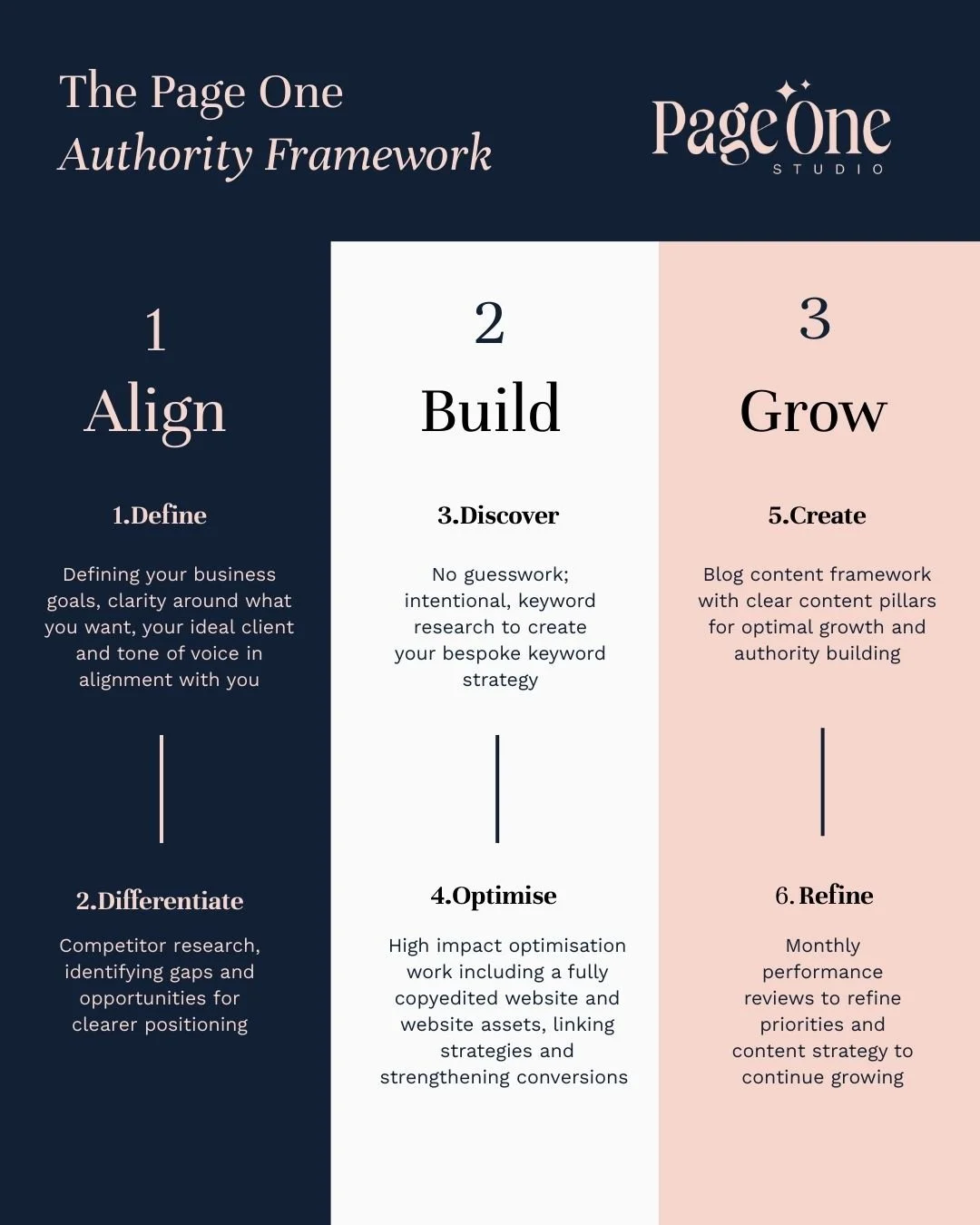
I’m going to assume that you already have the alignment part covered. That is:
• You know who your ideal client is
• Your services and offers meet their struggle
• You understand the language they use
• And most importantly, you’re completely aligned with those offers and love delivering them!
This is the first step that many people miss. You want to make sure you’re attracting the most aligned audience because it results in easier conversions. One of the objectives of your website should be making sales.
Once you’re aligned, you can start to look at how you begin to build.
Keyword Strategy for Ranking on Google
Doing keyword research is a core part of SEO and helps Google understand exactly what your content is about and who it should be shown to.
Look for high-volume, low-competition keywords to start with. I usually group these into two categories.
Keywords that are service and offer specific. For example, for my business, it might be “SEO Services for Small Businesses”.
Keywords that are problem-specific. For example, this blog covers: “How to get on page 1 of Google”.
There is another group that I like to call “Stealth Keywords”.
These are stealthy keywords not necessarily related to your business, but are of interest to your ideal client.
For example, if you’re a pet shop based in Nottingham, you might decide to create a blog around ‘Top Dog Walks in Nottingham” (and yes, this is a strategy I used with a client, and yes, we got to position one and gained a lot of new traffic!)
If keyword research feels like a guessing game, this is exactly the kind of thing I help my clients map out strategically.
Create High-Quality SEO Content (EEAT)
We’re quite lucky with SEO in that Google tell us pretty much exactly what we need to do to rank highly in Google. And that includes Google’s EEAT principle (Experience, Expertise, Authoritativeness and Trustworthiness).
You can cover these in a number of ways throughout your website, but keeping this in mind while writing will help with your content.
How Long Should a Blog Post Be for SEO?
I get asked often how many words are ideal when writing blogs. And the answer is always, as many as you need to answer the search query as succinctly as you can. I don’t tend to write content under 800 words as it usually takes at least that to cover a topic in enough depth to give the reader useful and educational content they can take away.
On-Page SEO: Where to Put Your Keywords
Knowing where to put your keywords is an essential skill for getting to page 1 of Google, but once you know how, it’s pretty easy to replicate the same process again and again.
Keywords need to be incorporated into your:
• URL
• Alt Text (where relevant – alt text is for screen readers first, always for accessibility)
• Page Title
• Headers
• Body Copy
Content Pillars and Internal Linking Strategy
I always tell my clients to think about their websites like a spider web of content. Everything is interconnected. You might have your main topics as service pages. Or article pages that go into the subject in more detail.
It really does depend on the type of business you have.
But essentially, these are your cornerstone pages, pillar pages, whatever you want to call them! Think of them as your high-level pages.
Then, from those pages, you’ll create more niche content around struggles or concepts that need explaining, educating, or problem-solving. This will help you to work out the right content for your blog.
How Backlinks Help You Rank on Google
Backlinks act as signals of trust to Google, helping to build your website’s authority and improve your chances of ranking higher in search results.
There are lots of backlink services out there that you need to be aware of. They might try to draw you in with big promises! But random backlinks from websites that have nothing to do with you could harm your website’s authority.
When looking for backlinks, you need to think of it from a PR perspective.
You can get backlinks from:
• Directories
• Guest blogging
• Guest podcasts
• Media opportunities
• Interviews
This is where PR is a BIG thing and needs its own strategy. I offer access to a PR membership with my SEO packages to get you started on building your story and learning how to pitch.
Set Up Your Google Business Profile
Even if you don’t have a local business, a Google Business Profile is a must-have. If you collect reviews and testimonials, I recommend you start asking for them through Google.
Ideally, you should treat your Google profile as a mini social media channel. You can post updates about your services and products, as well as new images. It helps people to get to know you and build trust at first glance, and it helps Google to understand and trust you too.
Technical SEO Basics: Speed, Fixes and Performance
Technical SEO ensures that Google can properly crawl, index, and understand your website, which directly impacts your ability to rank.
Check how fast your website is loading – there are loads of tools online to do this. Are your images too big? Videos slowing it down? Have you got links on your website that lead to nowhere because the page no longer exists (broken links)? These are all additional things to check out and fix.
They aren’t as BIG as the other things – but they still make a difference.
Have a Plan and Keep Implementing
SEO is not a one-and-done. Keep refreshing your website with new content. Talking about emerging trends. Updating old blog posts with outdated content.
At the end of the day, all Google want to do is return the best, most credible results to users. They need to make sure anyone using their services is not disappointed. So it’s looking for the best website possible, taking hundreds of factors into account. They don’t give us the full rundown of what these all are, but through experience and testing, we’ve got a pretty good idea of the most important ones, which are the ones listed here.
If you’re reading this thinking “this makes sense, but I’d never actually do it consistently” – that’s exactly where I come in.
Book a call, and I’ll let you know which package I think is right for you. I can create a strategy for you to implement, or do it all for you on 4 and 7-month packages.
Author Sam Milburn
An SEO strategist specialising in helping service-based businesses increase their visibility on Google through aligned, sustainable SEO content strategies.
FAQS: Getting on Page 1 of Google
How long does it take to get on page 1 of Google?
SEO is a long-term strategy. Most websites start seeing movement within 3–6 months, but competitive keywords can take 6–12 months or longer, depending on your industry and consistency.
Can I get on page 1 of Google without paying for ads?
Yes! Organic SEO allows you to rank on page 1 without paying for ads, but it requires consistent content, optimisation, and authority-building over time.
What is the fastest way to rank on Google?
The fastest way is to target low-competition keywords, optimise your content properly, and publish consistently. However, there are no instant results with SEO.
Do I need backlinks to rank on page 1 of Google?
Backlinks help build authority and trust, which can improve rankings. While you can rank without them in low-competition niches, they become more important in competitive industries.
How many keywords should I target per page?
Focus on one primary keyword and a few closely related secondary keywords. Trying to target too many can dilute your content and confuse search engines.
Is SEO better than social media for traffic?
SEO typically brings more consistent, long-term traffic, while social media is more short-term and requires ongoing effort. The best strategy is to use both together.