SEO Blogging Tips – How to choose the right content for your blog
Index
Introduction to blogging for SEO
SEO Blogging Tip Number One - Find out what your audience is REALLY looking for
SEO Blogging Tip Number Two - Think about WHO you want to attract to your blog
SEO Blogging Tip Number Three - Blog about one thing at a time
SEO Blogging Tip Number Four - Don’t chase trends if they don’t fit in with what you offer
SEO Blogging Tip Number Five - Don’t fall into the ‘fluffy clever naming’ trap
Conclusion
Introduction to blogging for SEO
Most people blog on their business website in a slightly sporadic way. That’s not to say the blog content isn’t good; often, it is, but it’s not written or structured in the right way for search engines.
I mean, you probably have no idea about SEO, right? Why would you? Most business owners are too busy learning about funnels and lead generation so that’s no shade on you. And if we talk about keywords, then I can imagine your eyes glazing over and your mouth drying up at the thought of anything technical.
SEO stands for Search Engine Optimisation.
We can optimise our content and website for search engines. This SEO can help you get to page one of Google for various search terms.
That’s the difference between writing a blog that you think your audience might like. And writing a blog you intentionally structured and wrote in a way that suits both Google AND your audience to generate leads and sales.
If you want to start to get free leads from Google (which I think is the MOST energy smart way of marketing your business), then all you gotta do is understand what content Google (and your audience) are REALLY looking for so you can create the ultimate collection of blog posts on your specialist subject.
That’s where I come in.
None of this over-technical, mystical rubbish about SEO.
Let’s get straight to the facts and talk about how to choose the right content for your blog with my top blogging tips for SEO.
SEO Blogging Tip Number One - Find out what your audience is REALLY looking for
I say this 100 times a day. Honestly. We can have the best intentions when it comes to blogging for our business. We want to write about the things we find fun. The things we THINK people are interested in.
But there are two things to consider.
1.Consider the words and phrases your audience uses
Firstly, how your audience phrases what they’re looking for might be different to how YOU word it. And I say that with certainty. Because words are important (so SO important) when we’re looking at blogging for SEO.
I always used this as an example a few years back when the term ‘reactive dog’ was less known.
In dog training, we call those ‘aggressive, barky and naughty dogs’ reactive. ( I have one – I know it’s a joy!) Reactivity is a phrase we use over and over again in dog training. Because we know your dog isn’t inherently aggressive. They are ‘reacting’ to a situation in an undesirable way.
But if your ideal client doesn’t yet know what a ‘reactive’ dog is, they might be searching for things like:
Why does my dog bark at other dogs?
Why does my dog hate people?
My dog bit me what do I do?
Is my dog safe with children?
Is my dog aggressive?
Put yourself in their shoes. Or go back to when you were in their position (as so many of you used to be your ideal client). What words do they use?
2.Consider the symptoms they’re experiencing
These are the symptoms they are experiencing because of the problem that needs solving. They might not know what the problem is yet. So, think about the things they’re googling at 11pm when they can’t fall asleep because of the symptoms they’re experiencing.
They usually start with phrases like:
How do I stop…?
What’s the best way to…?
What doesn’t… work?

SEO Blogging Tip Number Two - Think about WHO you want to attract to your blog
Another SEO blogging tip for you is to remember that what you DON’T write about in your blog is just as important as what you DO.
Why?
A whole host of reasons. But let’s say you only want people at a particular stage of their journey.
Imagine you’re a business strategist who helps people hit 6 figures a year. That’s your ideal client’s main goal.
So you wouldn’t blog about how to set up your email marketing, because your ideal client has already been there and done that.
Instead, you’d probably blog about:
where to find gaps in your marketing funnel or
how to position yourself as a leader in your niche
Those blogs will repel those who aren’t even considering those scenarios yet. Meaning you filter in the right people, at the right stage, looking for EXACTLY the thing you’re offering.
This means that anyone who visits your website it way more likely to convert and isn’t going to think twice about whether or not you’re the right choice for them.
SEO Blogging Tip Number three - Blog about one thing at a time
Generally you blog with one main keyword phrase in mind. And go all in on it. Sometimes we blog about a few different things. But keep it simple for now, keep in mind, one search phrase, one problem.
So let’s use the example ‘Why does my dog bark at other dogs’.
I’ve just checked and it gets 260 searches a month. So it’s a popular search term. Everything you write about in that blog is going to dissect that question into teeny pieces. You are going to write about it until you can write no more!
You’re not going to write about toilet training or getting a new dog. You’re going to speak specifically to the barking struggle.
If you talk about too many subjects in a blog, then it’s not sending strong signals to Google that your blog answers that key search phrase. It becomes weak. You dilute the message. So it’s likely to flop.
The blog might even sound boring to you! Because you know it all. But remember, your audience doesn’t! So spell things out super clearly for them, step by step, and answer the question clearly and succinctly. This is key to SEO.
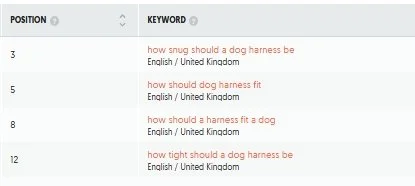
Eventually you might find your blog coming up for very similar search terms. Here’s an example of a harness fitting blog I created for my client.
SEO Blogging Tip Number four - Don’t chase trends if they don’t fit in with what you offer
I’ve fallen foul of this myself before. Blogged about something because it was trendy, but actually, it was not my expert subject matter, and it didn’t really make a lot of sense in the overall structure of my website. No SEO considerations.
If you start to go off on a tangent and start blogging about your trip to Alton Towers, or your dog, then you’re going to get the wrong people hitting your website.
You could end up confusing Google and start dropping in rankings on your other search terms, because you’re no longer seen as a content-rich website about one particular subject.
SEO Blogging Tip Number Five - Don’t fall into the ‘fluffy clever naming’ trap
If you have a suite of offers and services you’ve likely given them some very cool names. I see it everywhere. And honestly, it’s very cool I get it. It makes you stand out. But if you talk about that ‘thing’ endlessly on the page and don’t use ‘human speak’ as I call it, Google is going to be very confused about the ACTUAL thing you sell.
I’ll give you an example.
My client has a product called voicebox. He’s a tone of voice expert. He creates brand tone of voice for big clients. This product he’s created has an apt name. It’s totally fitting which his concept. And his sales page was coming up on page one of Google and getting clicks! Amazing right?
Well, it was coming up for search terms like ‘What is a voicebox’ and ‘How does a voicebox work’ and even just… ‘Voicebox’.
So sadly no.Those clicks were actaully harming his SEO becuase Google thought his webiste was about voiceboxes. And also, those people were bouncing straight off after realising they didn’t hit a webiste that told them how a voicebox works.
He was apearing in no mans land for any tone of voice enquiries. And yes, after 7 months work I’m proud to say he even hit position one for ‘tone of voice’. So my work there is done!
But the lesson here is - make sure Google knows in black and white human speak, what you do.
Conclusion
Writing does not come naturally to a lot of people. Honestly, I’m a complete freak of nature that I can sit at a computer and happily tap out a couple of thousand words at a moment's notice.
So when you DO write I’d love you to write with more strategy and intention. If you’re gunna do it, let’s do it right, right?!
Want to do blogging for SEO? I’ve got the perfect free resources over here that will help you!
You can also check out my range of free downloads here.
FAQs
How do I choose the right content for my blog?
Start by understanding what your audience is actually searching for – not just what you want to write about. Look at the words they use, the questions they ask, and the problems they’re trying to solve. Your content should directly answer those.
Should I write blog content based on what I enjoy? Like the things I’m up to?
Always prioritise what your audience is searching for. Writing only what you enjoy can miss the mark if it doesn’t match real search intent. But that isn’t to say you CANT post about what you’re up to. But there are other ways to do that.
How do I find out what my audience is searching for?
Think about:
The exact phrases they’d type into Google (you can find out for sure using software like Ubersuggest)
The questions they ask late at night when they’re stuck
The problems they’re trying to fix
You can also use tools like Google autocomplete, “People Also Ask,” and other keyword tools to confirm your ideas.
Should my blog target beginners or advanced clients?
That depends on who YOU want to attract. Your blog content should be intentional – writing for the wrong level can bring in the wrong audience and you don’t want that either! It will end in frusutrating discovery calls and wondering why you’re attracting the wring fit people. What you don’t write about is just as important as what you do. Skipping misaligned topics helps filter out the wrong audience and keeps your content focused.
What kind of questions make good blog topics?
Great blog topics usually start with:
“How do I…?”
“Why does…?”
“What is the best way to…?”
“What should I do if…?”
These reflect real search behaviour and are perfect for SEO and AEO.
Can blogging with SEO really generate leads for my business?
Yes! I always find this the hardest part to convince people. When your content matches what people are searching for, it can bring in consistent, organic traffic and convert people into leads over time. It also generates a huge amount of trust. I expect you’re reading this thinking ‘okay, she really knows a thing or two about SEO’. How can you do the same for your audience?
How do I know if a blog idea is worth writing?
Ask yourself:
Is someone actively searching for this?
Does it solve a real problem?
Does it align with my services?
If the answer is yes to all three – you’re onto a winner.
What’s the biggest mistake people make with blog content?
Writing based on assumptions instead of actual search behaviour. This leads to content that feels good to write… but doesn’t get found.